The
Highway Safety Act and the National Traffic and Motor Vehicle Safety
Act were passed in 1966. they authorized the federal government to
regulate vehicle and highway standards and created the National Highway
Traffic Safety Administration (NHTSA). These measures led to many
improvements in auto design, including the mandatory installation of
seat belts in American cars..
Prior to 1966 seatbelts were not
required in a vehicle, they were offered as a factory extra even as far
back as the early 1900's..As current law stands you are only required to
have the safety equipment on your vehicle that came standard from the
factory when the vehicle was made.. So if your classic car did not come factory equiped with seat belts you don't have to have them..
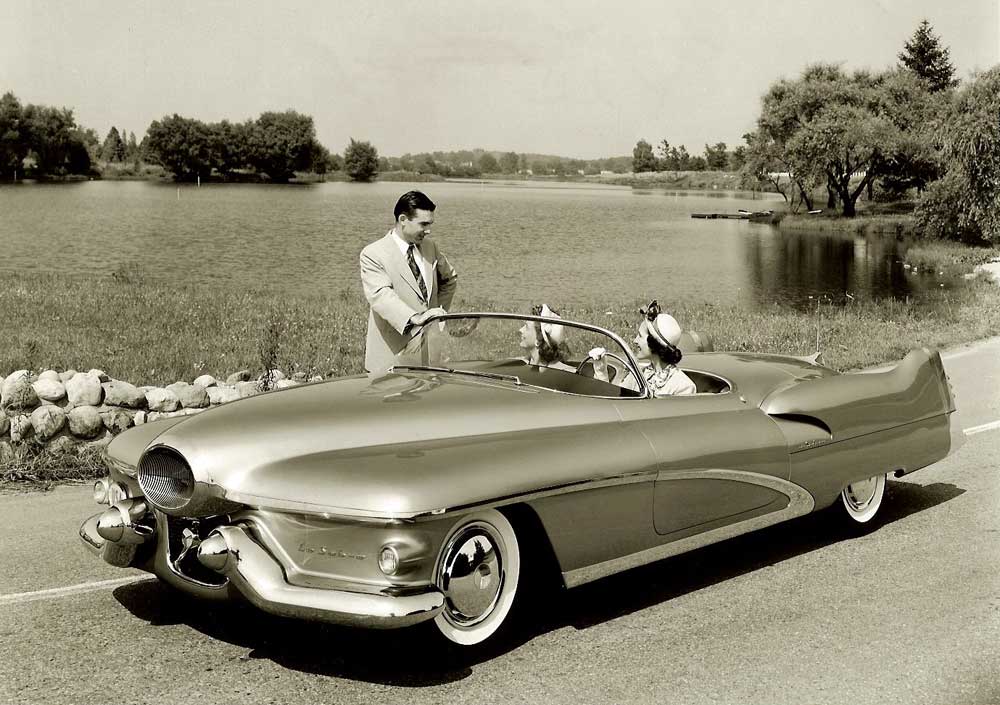
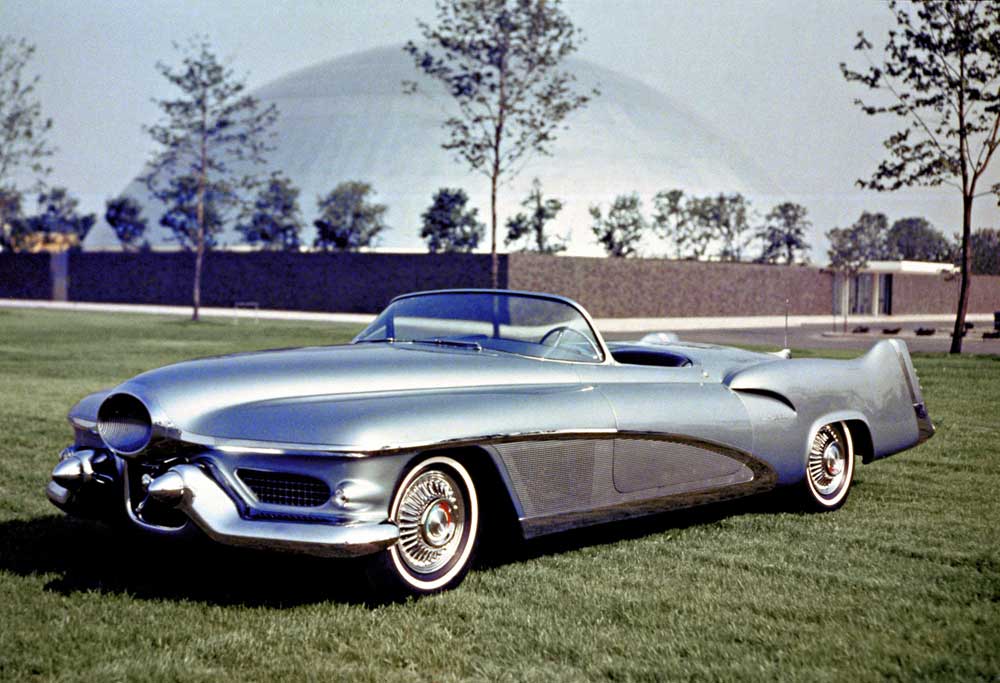
1951 GM Le Sabre: Indisputably the most famous and influential concept
car of the 1950s, the Le Sabre served as GM design chief Harley Earl's
(pictured) daily ride for two years after it returned from the Motorama
circuit.
1951 Buick XP-300: With a lightweight aluminum body and a supercharged 335-hp V-8 engine, it could hit 140 mph.
1953 Cadillac Le Mans: A low-slung two-seater created to commemorate Cadillac's run in the famous 24-hour race of the same name.
1954 Buick Wildcat II: It made use of a 322-cubic inch V-8, a year before the Corvette would move to eight cylinders.
1954 GM Firebird I: One of GM's wildest, most overtly jet-inspired visions of our motoring future, seating one.
1954 Pontiac Bonneville Special: This curvaceous version of the Chevrolet Corvette never saw production.
1956 Buick Centurion: Despite its transparent top and fiberglass body, this coupe predicted Buick's style into the 1960's.
1956 GM Firebird II: This version of GM's jet-inspired creation seated four.
1956 Oldsmobile Golden Rocket: A lightweight, fiberglass-bodied sports coupe with a 275-hp Rocket V-8 engine.
1959 Cadillac Cyclone: This rocket-styled roadster included a
crash-avoidance system that used radar sensors mounted in the car's
nosecones.
Before TV advertising really took off,
General Motors designed futuristic concept cars to show off to the
public at a series of lavish "Motorama" auto shows.
From 1949 to 1961, General Motors dazzled the public with its vision of
our automotive future: Motorama. With singing, dancing and live music
(not to mention free admission), Motorama auto shows were, in an era
before TV advertising really took off, the ultimate corporate
infomercial, drawing millions of wide-eyed car aficionados.
Auburn, Indiana is widely considered the "classic car
capital of the world", and it lives up to its reputation by holding the
Auburn Cord Duesenberg Festival on Labor Day weekend every year. This
year, the festival is in its 54th edition, and it will be held from the
2nd of September to the 6th of September, 2010. More than 200,000 people
from across the United States and other countries are expected to
attend this grand and exciting festival.
The festival will
feature lots of interesting classic car-related events, including a drag
race, auctions, cruise-in, arts fair, and much more. The Auburn Cord
Duesenberg Automobile Museum will be holding extra events throughout the
festival, including the 5th ACDA Museum Benefit Extravaganza, the Arts
Show and Sale, the Connecting Rods Luncheon, and the Gala Ball for
museum members. One of the highlights of the festival is the downtown
cruise-in, which will attract more than 700 participating vehicles as
well as thousands of spectators. Those who enjoy drag racing can attend
The Ab Jenkins Memorial Duesenberg Exhibition of Speed and Stinson
Fly-In, a thrilling drag race at the Kendallville Airport. Auctions that
will be conducted during the festival include The Auburn Auction by
Worldwide Auctioneers, Auctions America by RM, and Classical Event
Auctions.
Other notable events that will be organized during the 54th Auburn Cord Duesenberg Festival
include the ACD Parade of Classics, Cars and Guitars, Garage Cruise,
Classic Car Masterworks, Motoring to the Square, Auburn Arts Fair, Brain
Games, and others.
The
word "Classic" is a derivative of the word "Class" which means a higher
standard, something that has standards that others do not have.
Look at the E-Type Jaguar for example it oozes class. Or how about the Porsche 911 with its whale tail.
If the E-Type Jaguar was built to day it would still turn heads.
That's a "Classic Car".
"Vintage"
(depending on where you are) usually denotes a car that is at least 30
or 40 years old.
"Antique" is older than that (some jurisdictions have
special licences for these types of car).
A "classic" car is
generally one whose design, styling or performance was considered
exemplary in its day, leading to collectors wating it. Some British
classic cars would include the Jaguar XK120 and 150, the early MGs (the
MGA for example), the Austin Healey 3000, many models of Bentley, Rolls Royce, Aston Martin, Morgan, the Sunbeam Tiger, etc.
Paul was interested in cars for as long as he can remember. One day
the shop manager at a local Pontiac dealership let him drive his
beautiful MG TC home to show his mother in hopes of getting one for his
High School graduation, but that didn’t happen. So the first thing Paul
spent his money on while in the Army was a MG TD. He attended many
sports car races in the east, including the Sebring 12-hour
International race.
Paul graduated from Pratt Institute in June, 1954 with a Bachelor’s
Degree in Industrial Design. He was hired by GM Styling after being
interviewed by Bill Mitchell, and began his career in the Orientation
Studio, then was moved to Pontiac Studio under Paul Gillan and worked on
the Strato Star show car.
The Army interrupted his career. Paul was inducted into the Army in
December, 1954 at Fort Dix. He was transferred to Ft. Knox and served as
battalion photographer, in the 339 Corps of Engineers unit. He went
through training at Ft. Eustis for Project Dewline West (Alaska and
Canada), where he served as instruction cadre in cargo registration. On
return from the arctic, Paul made a plaster scale model of the future
site of the Jamboree at Valley Forge that they were to build. He served
on a survey crew, as a photographer, and as a company orderly. Paul was
discharged in December, 1956.
Paul returned to Styling in January, 1957 to orientation studio for
short period. There he worked on Stingray proposals. Then back to
Pontiac studio under Paul Gillan and later under Joe Schemanski, and
worked on the ’59 Pontiac. He contributed to the front and side spear,
wheel discs, and rear quarter treatment. Upon transfer to Pontiac, Paul
quickly sold his MG TD and moved into a new 1957 Corvette.
In late ’57 Paul was transferred to Chevrolet under Claire MacKichan.
He worked on ’60–’63 Chevrolets, contributing to new fronts, side, and
rear end treatments, front end panels and décor for the Corvair, and
minor Corvette grille changes. He was credited for the ’61 front, the
’62 rear, and the ’61 Corvair front.
Your cars of tomorrow are being designed at Pontiac today.
In ’61 Paul moved to Buick under Bernie Smith. There he contributed to
the ’63 Electras, LeSabres, and the compact Buick Skylark. Buick studio
was taken over by Dave Holls. Paul also contributed to Riviera, Electra
LeSabre, and the new Skylark designs.
Paul was promoted to Asistant Chief Designer in ’62 and transferred
into Pontiac Studio under Jack Humbert for the ’64–’67 programs,
including the new GTO option for LeMans, the B-body Catalina, the Grand
Prix, the A-body LeMans, and the X-400 show car.
He was again transferred to Moved to Buick in 1965, as Assistant to
Dave Holls. He worked on the new Electra, LeSabre, Wildcat, Skylark, and
GS models. Buick Studio was taken over by Don Lasky. Paul was moved to
Studio X for a while to work on the ’67 Firebird lead-in.
Leading up to Germany’s 1939 invasion of Poland, certain high members
of the Third Reich were flaunting their national pride and power by
using a visual cross-reference language or techniques to mesmerize the
German public. Politics combined with modern Teutonic engineering
ingenuity had never been successfully employed like this before.
Germany’s racing propaganda machine was the Mercedes Benz W125, arguably
Europe’s most futuristic pre-war sports car. Special notice was taken
in Detroit’s auto capital, and Harley Earl vowed to deliver a triumphant
message all of his own someday.
The original 1951 version of the car.
When things were settling down in Europe following the war, one of
America’s most legendary innovators created a clever comeback in the
form of an automobile (according to the Car of the Century website, the Le Sabre was started in July, 1946).
Originally planned as a super streamlined car, the Le Sabre comprised
more variations on a theme than Bach ever dreamed of—all of which were
aimed at winning over a world audience. In the best-selling booked
titled, The Fifties, David Halberstam wrote, “Other GM execs
drove Cadillacs, but Early drove the Le Sabre, a highly futuristic car
he himself had designed; the cost to the company of building this
prototype was estimated at roughly $7 million. It is possible that no
one exerted as much influence on American style and taste in the fifties
as he.”
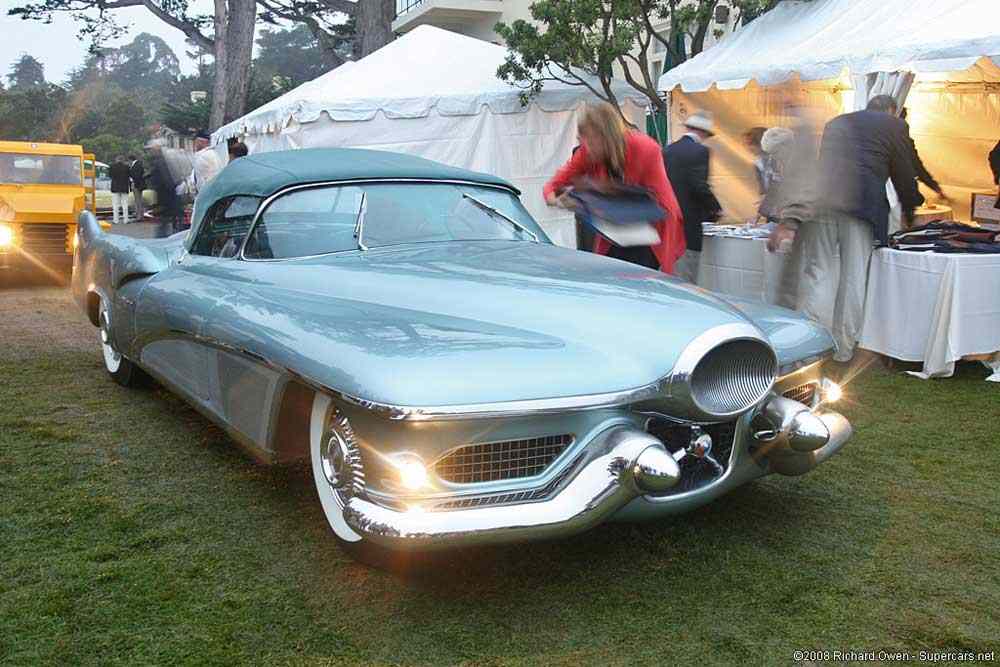
The 1954 version of the car with front end design modifications to improve cooling, and the skirts removed.
While this radical concept car had many purposes, the most intriguing
one was never publicized. The Le Sabre’s emblem was a flipped Mercedes
Benz tri-star logo, surrounded in a bull’s-eye like center
target—blending in America’s color of red, white, and blue. Along with
the elegant French name symbolizing strength, the Le Sabre was complete.
The inverted Mercedes star as a visual hook was truly mysterious, to
say the least, as were most of the Le Sabre’s touches. Every one sent
out spooky effects to all of its viewers. It’s no doubt the wizardry
was intended to remind the new world community of America’s supremacy
and future direction, which of course was opposite of Germany’s pre-war
view. Also, in a subtle way, this one automobile clearly pointed out the
world’s greatest automaker, too, as well as showing Le Sabre was the
most influential car, ever. In terms of numbers and fiance, it is the
most expensive car built to date, but because of certain reasons, one
being Earl’s secretive nature, this fact has been left largely
unexamined. On top of all of this, Harley Earl named Le Sabre as his
inspirational muse when originally conceiving his American sports car,
the Corvette.
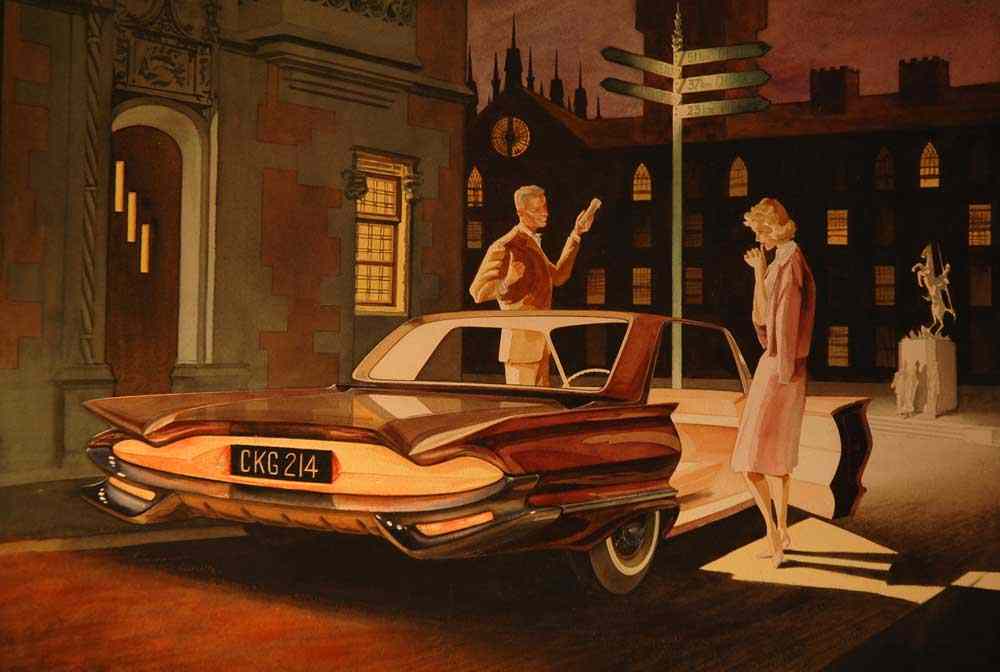
About Jeff’s Collection: “I began collecting after reading car designer
biographies and seeing styling art published in Collectible Automobile
Magazine during the mid 1980′s. By contacting retired designers, I found
that some were willing to give or sell pieces from their portfolios. I
always had a deep interest in automobile design history, especially GM,
and was fascinated with the designers stories, especially the early days
with Mr. Earl and Mitchell. I read everything I could find and
interviewed many people in the design field over the years. Chuck Jordan
and most of the designers I met were supportive of my efforts and
agreed this art was special and should be saved, I cherished it. After
some time, I found a small network of like-minded collectors to trade
and share information with. Much of the art from the Earl/Mitchell eras
has been lost and it’s rare today to find much of anything, I continue
to look and remain interested in adding to my collection.