Sunday, December 1, 2013

Editors' Picks: Our Dream Cars

As auto writers, it is a guarantee that people will ask us two questions whenever we tell them about our jobs: One: "What car should I buy?" Two: "If you could have any car, what would it be?"

Neither of the questions are particularly easy to answer. The first often opens up a can of worms of questions about budget, segment preference, family life, dog size, etc.

The second is even tougher because, well, there are a lot of awesome cars out there. We love cars. We think about them while we eat and before we go to bed. Often, we find ourselves at a loss for an answer.

In spite of this difficulty, we're going to give it a shot. We recently asked the AOL Autos and Autoblog editors to come up with the one car that they would absolutely have to own if they had all the money in the world and came up with this rather eclectic master list.

Here are the dream cars of people who dream about cars for a living. Click through to see what we would drive, and make sure to let us know what you would pick, too.

John Neff (Editor-in-Chief, Autoblog): Audi RS7

My lottery-winning fantasies tend to base themselves in reality, which is why I'd choose the Audi RS7 as my dream car. I can park it in my middle-class suburban, driveway and remain somewhat conspicuous, and the A7 on which it's based is both gorgeous and surprisingly practical with its rear hatchback. And being the RS7 model, I'd have enough power to embarrass most sports cars on the road.

Steve Ewing (Senior Editor, Autoblog): 2007-08 Audi RS4

I am not an extravagant man. To me, a "dream car" is the sort of automobile that I would want to drive every day in every situation. I want to be able to carve canyons one minute, and pack it full of groceries the next. It needs to be fun and functional all year 'round, and because of that, exotic supercars don't make the list. Oh sure, they're a riot to drive, but imagine slogging to the supermarket in a snowstorm behind the wheel of a Ferrari 458. Bummer.

The Audi RS4, however, checks every one of my boxes. Sold from 2006 to 2008 in the US, the RS4 was a darling little sport sedan, packing 420 horsepower and 317 pound-feet of torque from a high-revving 4.2-liter naturally aspirated V8 – one of my favorite engines of all time. It could hit 60 miles per hour in under five seconds, only came with a six-speed manual transmission and sent its power to the ground via Audi's remarkable Quattro all-wheel-drive system. Regardless of weather or road conditions, the RS4 was simply a blast to drive, with excellent steering, tons of power on demand and just endless amounts of grip. But it was also comfortable, refined and packed to the gills with luxurious amenities. The RS4 was simply one of the most perfect cars I've ever encountered, and to this day, I still dream about putting a Sprint Blue example in my garage.

Michael Zak (Consumer Editor, AOL Autos): Mercedes-Benz SLS AMG

If I had access to unlimited money, the car I would buy is undoubtedly the Mercedes-Benz SLS AMG. I've put a lot of thought into why this vehicle resonates so deeply with me, and I've come to the conclusion that it's simply because it embodies everything I am not. This car is loud, ostentatious, expensive, burly, utterly impractical and, in short, just plain awesome. For me, owning this car would be a classic case of compensating, and I'm perfectly OK with that.

Just look at those gull-wing doors. That ginormous front end. That insane grille complete with a Mercedes badge the size of beach ball. The design of the SLS AMG is the craziest combination of sleekness and brutishness on the road today. And I can't get enough of it.

The best thing about the SLS AMG, though, is how it combines its wonderfully absurd design with great performance. The supercar's 6.2L V8 engine produces, in addition to a savage roar, 583 hp and 479 lb-ft of torque, which translates to a 3.7 second 0-60 mph sprint. Wow.

Chris Paukert (Executive Editor, Autoblog): Ariel Atom 3

undefined

It's not rational, it's not practical, it's not refined ... it's not even weatherproof. Starting at $56,480, it's not cheap, either. What it is, however, is singularly focused on driving enjoyment and straightening out the corners of a canyon road or roadcourse. It's light – just 1,350 pounds – which means that even with its modest Honda-sourced 230-hp, 2.4-liter four-cylinder, it has enough power to hit 60 mph in under 3 seconds. That's just quick enough to change your life and contemplate bankrupting your child's college fund. It is the joy of driving distilled to its purest essence – it is the Ariel Atom.

Erin Marquis (Programming Manager, AOL Autos): Ferrari GT 250 California Spyder

I was introduced to this car, as was the case for so many of my generation, by the film 'Ferris Bueller's Day Off'. Since then I've dreamed of snubbing my nose at authority figures and speeding from adventure to adventure in this racy convertible.

This car is so sexy it's easy to forget that it's fast too. The Spyder comes equipped with the same engine as a 250 Tour de France racing car. That's 230 hp packed into a slick aluminum body. Only 50 were ever made and they routinely sell for millions of dollars today. The price and rarity of the 250 GT California Spyder makes it a true fantasy car. A girl can dream, though.

Pete Bigelow (Associate Editor, AOL Autos): 1968 Cadillac Fleetwood

Some people will inevitably pick the fastest car on the road as their dream car. Some people will pick the most powerful. I’ll take the biggest, or something close.

The heyday of America’s love affair with big sedans may have arrived in 1968. On television, Steve McGarrett screeched around every corner in Honolulu driving Ford sedans on Hawaii Five-0. In showrooms, Cadillac sold the exquisite ’68 Cadillac Fleetwood.

In my book, there’s no more perfect car. There’s not necessarily rhyme or reason to this. Just a gut feeling. With a polished black exterior and perfect white-wall tires, it looks near presidential.

Two years later, the Fleetwood would lose some of its luster when Cadillac did away with the stacked-headlight grille in favor of the side-by-side lights. In 1973, the first oil crisis would start spelling the end of the great sedan. For sedans, there was never another year like 1968.

Seyth Miersma (Senior Editor, Autoblog): 1974-76 Lancia Stratos

The unlimited-funds, era-no-object Dream Car question is as tantalizing for me as it is impossible to answer. Depending on the time of day, time of year and how big a lunch I might have eaten, my answers could range widely. Still, if there’s one car that I’ve lusted after more than any other since I was just a wee child, it has to be the Lancia Stratos.

The Statos is dreamy for any number of substantial reasons. The Lancia was rallied to championship results for three years from 1974 to 1976, so it has honest motorsports pedigree. Despite the relatively unknown brand (Lancia has been around in Europe forever, but doesn’t really register on most Americans’ radar), the car has a blueblood engine in the form of a 2.4-liter Ferrari V6. But mostly, the Bertone-penned bodywork of the Stratos makes it look like the motive version of illicit sex with an Italian runway model on a Sicilian beach at midnight.

As far as dream cars go, the Statos is a downright bargain, too. I saw a stunner of a ’72 model sell at Pebble Beach this year for around $375,000. That’s chump change to your typical Ferrari guy.

Jeremy Korzeniewski (Managing Editor, Autoblog): Volkswagen Type II Bus

undefined

Call me crazy, but there isn't an exotic vehicle in the world that appeals to me in quite the same way as a vintage Volkswagen Type II bus, naturally a 21- or 23-window example with pop-out Safari windshields and a canvas roof. I'd prefer it to look mostly stock, perhaps lowered a little bit with an aftermarket air suspension system and a set of era-appropriate wheels with modern tires, but the engine would get some attention. I'm pretty sure I'd start with an air-cooled Volkswagen engine block, though I'd also entertain the notion of a Subaru boxer engine, and I'd add a turbocharger.

Since money is no object (hey, it's my Fantasy Garage after all...), I'd go with a stock-looking interior, but I'd add a few modern conveniences like a good stereo system and reasonable air conditioning and heat. I'd top it all off with a two-tone paint job, the color of which I'd decide on after much internal debate. And then I'd drive it, every day and everywhere.

Adam Morath (Executive Producer, TRANSLOGIC): DeLorean DMC-EV

DeLorean DMC-EV

When considering my choice for "dream car," I started with one criteria: it had to be electric. As the editor of our TRANSLOGIC site, not only am I convinced that electric propulsion is the way of the future--be it traditional battery-electric or hydrogen fuel cell--but also that an electric car doesn't have to be boring. On the contrary, an electric car can be the stuff of dreams.

Now which one to choose?

The Chevrolet Volt is an everyday electric whose backup gas generator and reasonable lease price makes it a pragmatic choice for those living in EV-infrastructure-challenged parts of the country, like Metro Detroit. But pragmatism does not a dream car make.

The Tesla Model S gets closer to dreamland by blending high-tech features and performance with an EV ethos, making it one of the most talked about cars of the past year. Indeed, it's such a popular topic of conversation these days that it seems like too obvious of a choice.

A "dream car" should feel unique; almost unattainable. It has to be the sort of car you would chase down the street as a kid, should you ever be lucky enough to see one in the wild. For me, that car was the iconic DeLorean DMC-12.

As we chronicled in an early episode of TRANSLOGIC, the original DeLorean DMC-12 didn't exactly live up to its futuristic sports car billing. With only 130 horsepower, there wasn't much performance to speak of and, unlike in the movies, it could neither fly nor travel through time.

The custom Electric DeLorean DMC-EV seeks to resolve some these performance and technology issues with a modern 215 kW electric powertrain and revamped, coach-built interior. It looks just like the original from the outside, but the gas tank and engine is swapped for a Flux Power LifeP04 battery pack and 400 volt AC induction liquid-cooled electric motor that makes 260 horsepower and 360 pound-feet of torque. Top speed is reported at 125 miles per hour, with a zero to sixty mph time of just under 5 seconds. A custom 240 volt, 70 amp charger is said to fully recharge the battery in just 3.5 hours, good for over 100 miles of city driving.

The interior receives a modest upgrade as well. The DMC-EV travels to the 21st century with an smartphone dock, navigation screen, dial controls and a 3-spoke leather-wrapped steering wheel.

Mixing an icon of the past with the latest in technology? Now that's what dreams are made of.

Chris McGraw (Associate Multimedia Producer, AOL Autos): Ford GT40

1968 Ford GT40 Gulf/Mirage

In the 1960's, Ferrari was undefeated at the 24 Hours of Le Mans, at least until this 40-inch tall racecar showed up. In 1966, the GT40 delivered Ford its first win at Le Mans, and dominated the race the next three years. The Mk IV version that took home the trophy in 1967 is still the only entirely American made car to win.

With only 107 made, the GT40 is incredibly rare and expensive, but for a mere $200,000 you can pick up a used 2005-06 Ford GT, which is visually based on the Le Mans Champion.

Source:  autos.aol.com

Thursday, November 28, 2013

Wednesday, November 20, 2013

Mercedes-Benz AMG Vision Gran Turismo

undefinedFor the new PlayStation® 3 racing game Gran Turismo® 6, the Mercedes-Benz designers have developed the visionary concept of a super sports car – the Mercedes-Benz AMG Vision Gran Turismo. Extreme proportions, sensual contours and intelligently implemented high tech blend to form a body that visually brings to life the breathtaking performance of 430 kW (585 hp) and 800 Nm of torque. As a 1:1-scale model, the Mercedes-Benz AMG Vision Gran Turismo is celebrating its world premiere on 19 November 2013 at the opening of the new Mercedes-Benz Research & Development Center in Sunnyvale, California. The super sports car withwîth its hallmark Mercedes gullwing doors will be taking to the virtual racetrack when the new racing game goes on sale in December 2013 – as the first of the 'Vision Gran Turismo' series of vehicles.


2013 Mercedes-Benz AMG Vision Gran Turismo Concept Image
To mark the 15th birthday of the popular Gran Turismo® series this year, Kazunori Yamauchi, Producer of Gran Turismo series and President of Polyphony Digital Inc., called upon the world's leading automotive manufacturers and design studios to look forward into the future. Úsing the theme 'Vision Gran Turismo', these creative teams were to develop concept models which give a unique insight into the further development of the automobile. As virtual vehicles that nonetheless function just like a real car, the visionary concepts will be gradually unveiled in and integrated into the new game Gran Turismo® 6 through online updates.

Extreme proportions and variable LED radiator grille'By virtue of its proportions and expressive appearance, the Mercedes-Benz AMG Vision Gran Turismo embodies the brand's defining design philosophy of sensual purity in a unique way. The design of this concept car reflects to extreme effect the perfect symbiosis between emotional, sensuous contours and intelligently presented high tech,' says Gorden Wagener, Vice President Design Daimler AG.
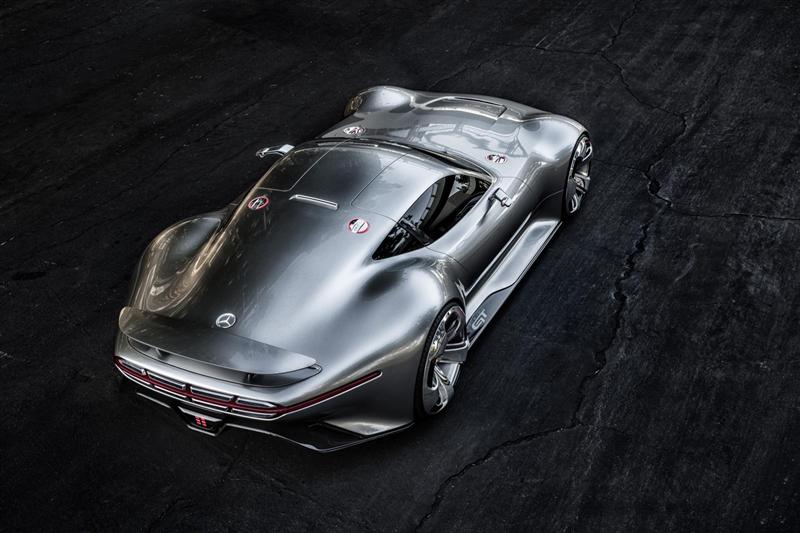
The sports car proportions that are a typical Mercedes feature have been reinterpreted: the long bonnet has a flowing transition into a compact greenhouse offset to the rear, which takes the form of an aerodynamically efficient water drop to descend slightly at the rear, where it rests on the rear end with broad shoulder contours. The dynamic aura is accentuated by an extended, dramatic side contour and a pronounced bulge to the wheel arches, which blend into the low-slung, muscular bodyshell. The angled headlamps, wîth their colour scheme and determined look, convey a sense of sportiness and readiness to leap forward. This impression is reinforced by the bonnet with its expressive forms and motorsport details, such as the release catches on the bonnet and the fuel cap, for example. The red-glowing contour lines on the lower part of the vehicle create an effect similar to that of exterior ambient lighting and stand out from the silver-painted bodywork. This makes the Mercedes-Benz AMG Vision Gran Turismo look even more aggressive.


2013 Mercedes-Benz AMG Vision Gran Turismo Concept Image
Another eye-catching feature is the radiator grille – a reinterpretation of the wide Mercedes-Benz sports car grille with central star. Its shape is reminiscent of the legendary 300 SL racing car of 1952. However, instead of classic louvers the grille of the show car features exclusively LED's. The variable LED grille with different light patterns is a further development of the diamond grille introduced with the new A-Class.

Purist interior dedicated to speed

The exterior design, which is systematically and passionately geared to motor racing, is congenially mirrored in the interior of the two-seater. Inspired by the Formula 1 cockpit, the red integral sports seats blend into the black flooring of the foot well to form a protective shell. The form of this flowing, sculptured shell suggests enormous forward thrust. The dashboard also creates an equally dynamic effect. It has been designed in the form of two gull wing doors which are positioned on each side of the steering column. As a result the actual doors themselves appear to be an extension of the instrument panel.

The central display is optimally positioned in the driver's field of vision: it takes the form of a glass surface floating directly above the racing steering wheel with its shift paddles, and shows all the relevant information such as road speed, engine speed and operating temperature as required. Operation is by rocker switches in the center of the dashboard and in an overhead console, like in a jet. The steering column visibly penetrates the firewall to the engine compartment, creating a visual connection between the driver and the heart of this super sports car, the AMG V8 front-mid engine.

Intelligent lightweight construction and authentic racing car sound

The AMG V8 biturbo engine delivers an exceptionally agile response to even the smallest movements of the accelerator. It develops 430 kW (585 hp) and a maximum torque of 800 Nm. With an aluminum space frame body and components in carbon fiber, the material of choice in motor racing, the Mercedes-Benz AMG Vision Gran Turismo tips the scales at only 1385 kilograms. That amounts to around 2.4 kilograms per hp – an unrivaled figure in the super sports car  segment, and one that guarantees exceptionally dynamic performance. Excellent deceleration values and fade resistance at the highest level are ensured by the AMG ceramic high-performance composite braking system. The AMG sports exhaust system with eight tailpipes integrated into the rear end provides a powerful accompaniment whenever the car accelerates, and ensures an unrivaled motorsports sound experience. For fans of Gran Turismo® 6, the Mercedes-AMG sound specialists have created a powerful, sonorous exhaust note that authentically celebrates the V8's love of high engine speeds.

Source - Mercedes-Benz

Thursday, November 7, 2013

Bay to Birdwood 2010

Andrew Costi and his Jaguar

Click Here to check out my friends photo's of vintage cars in Australia.

Source:  gawler.homestead.com

Wednesday, November 6, 2013

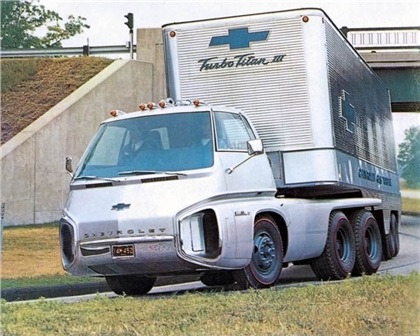
1965 Chevrolet Turbo Titan III

Chevrolet Turbo Titan III, 1965

GMC Turbo Titan III

The Turbo-Titan III used a pearlescent white fiberglass and steel cab combo with its styling theme extended to the chassis, which was completely concealed by molded fiberglass panels. Doors mounted just ahead of the rear wheels on both sides of the skirt provided access to dual batteries and the turbine engine when the cab was electrically tilted. Power-operated wing-type side windows with top hinges provided operator entry when the key was inserted in the door. Retractable square headlamps were mounted within functional air intakes in two banks of three lamps each. The front turn signals were retractable, with the rears operating in sequence, flashing inward. A flat exhaust stack exited through the roof.


Inside, "Astronaut Seats" with full headrests were mounted on each side of a center console. A wing-topped handle controlling the six-speed automatic transmission was mounted on the console. Full interior carpeting was included along with retractable seatbelts, air-operated windshield wipers, full tinted glass, and air conditioning/warm air heating. A four-speaker FM stereo radio and a two-way telephone were used for the first time.
 
Chevrolet Turbo Titan III, 1965 - Interior

The most novel feature, though, was the GM designed and engineered "dial steering system." This unit was mounted on a pedestal in front of the driver, replacing the conventional steering column and wheel. Twin dials mounted on a padded vinyl panel operated the platforms power steering. An auxiliary pump driven from the propeller shaft provided emergency usage if the main pump failed for any reason when the platform was in motion. The automatic transmission quadrant was also mounted on this panel along with the turn signals. The pedestal pivoted forward and back along with the panel for the most comfortable driving position.
 
Chevrolet Turbo Titan III, 1965 - Magazine Ad 
Chevrolet Turbo Titan III, 1965 - Magazine Ad

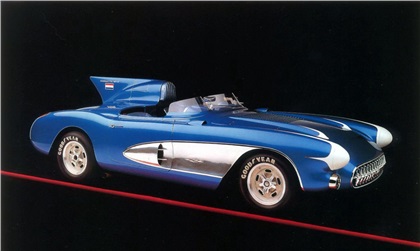
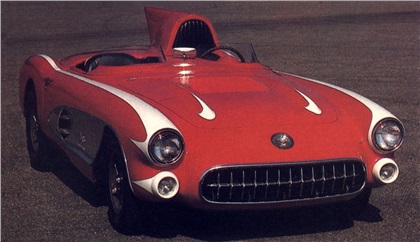
1956 Chevrolet SR-2

Chevrolet SR-2, 1956

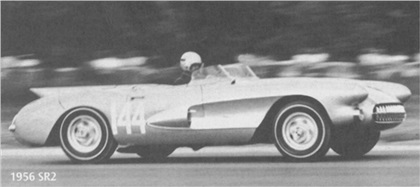
A stock Vette with a longer nose, side scoops, and a dorsal fin, the SR-2 was raced by Harley Earl’s son Jerry and used to prove out heavy-duty components later offered on production cars. It was banished from the show circuit when the Big Three swore off racing.
 
Chevrolet SR-2, 1956
 
The SR-2 acronym stood for “Sebring Racer” or alternatively “Sports Racing”. Starting with a Sebring Corvette chassis, the SR-2 sprouted a rear fin, two small racing windscreens, air scoops on the side coves and an extended front end with driving lights that gave the machine a purposeful appearance.
 
Chevrolet SR-2, 1956

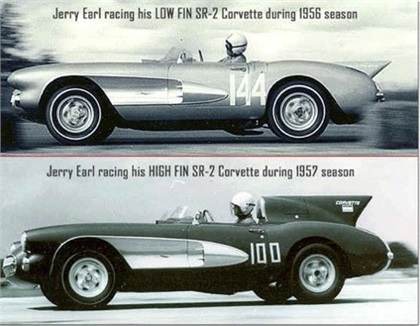
When Jerry Earl announced he was going to race a Ferrari 250 MM, his father, Harley Earl, commissioned a racing Corvette for him instead. Chevy already had the 1956 Sebring Racers, but Harvey Earl had his designers create a hotter looking Corvette for his son to race. The result was the very first Corvette SR-2.
 
Chevrolet SR-2, 1956

This “low fin” design had a rear fin that had the same height as the top of the rear deck. It also had a longer nose as the standard Corvette, fairing cones for the headlamps, fog lights in place of turn signals and air scoops at the end of the body side cove. William L. Mitchell had an SR-2 built with a taller fin integrated into a Jaguar D-type style of headrest. Notice the Corvette logo on the tail fin!
 

1956 Chevrolet Impala Show Car

Chevrolet Impala Show Car, 1956

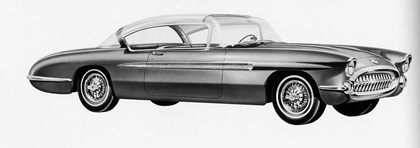
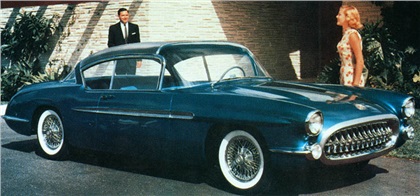
On July of 1955, the Chevrolet design studio staff create a dream car for the 1956 GM Motorama shows, called Corvette Impala. The Corvette grille and grille surround are incorporated, as well as other Corvette components. This hardtop five-passenger sports sedan shows the name "Corvette Impala" on the front emblem and rear license plate. On January 19 of 1956 the Motorama show opens in the Waldorf Astoria in New York City, running for nine days. The 1956 Corvette makes its debut and the Corvette Impala show car is displayed.

Chevrolet Impala Show Car, 1956

Chevrolet Impala Show Car, 1956

Source: shorey.net