Thursday, November 8, 2012

Homemade Car From Parts Found On The Farm

When you live on a farm you learn to "make do" with whatever you find in the barn!!

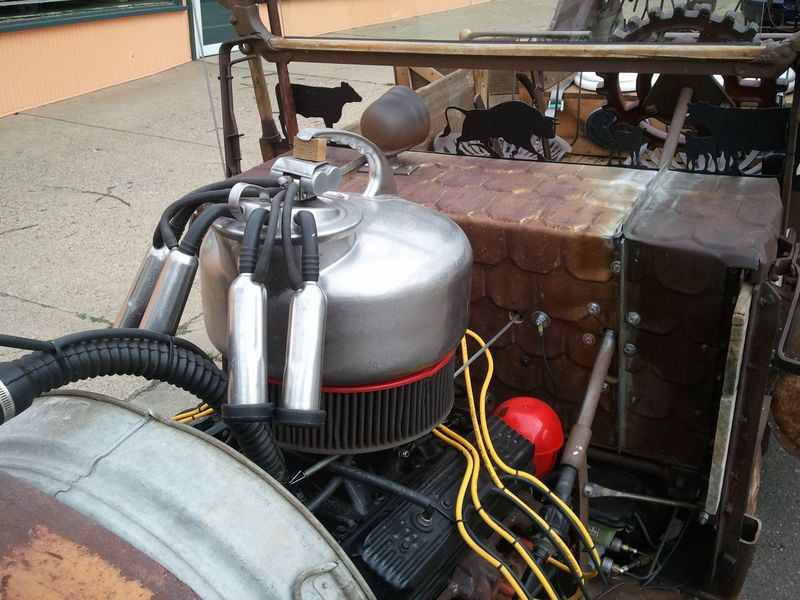
This is the exact and perfect example of why we save everything. This car has been built with all of the “junk” laying out back in the pile, and under the work bench, and stuffed in the rafters. All this guy needed was a little time on his hands.

Spotted in Cannon Falls , MN on 5/23/12 – It’s a car? or a truck?


Milk Can Fuel Tank


Check out the “gearing wheel”... What do you see?

Dash is a saw blade with handles attached - tractor hand brake - tachometer - Two mirrors mounted on horse shoes - big truck signal switch mounted on left - single wiper motor -


How many men who grew up on a farm are now thinking – Why didn't we do that?


Cow milking apparatus on air cleaner - galvanized wash tub fan shroud -


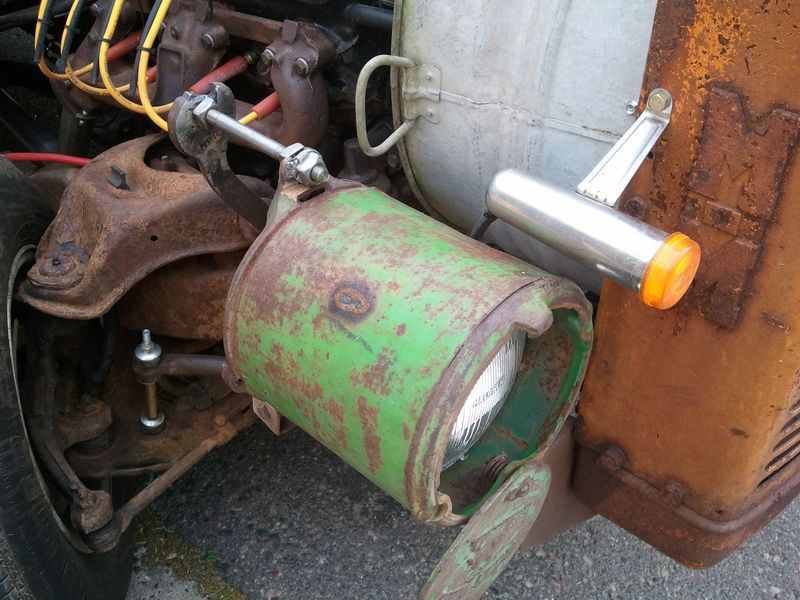
Tractor wrench bracket for headlamp housing -


Rear seats from toilet with stereo speakers below them -New home seat backs including an Oxen yoke!!


The rear lamp frame built with saw blades and a chicken feeder box - manure spreader drive is still intact - horse shoe door hinges.


Tractor seats with pitchfork backs - seat belts - tractor compartment box behind driver seat - gear shift beside hand brake - stereo & CD player on dash blade - the drive chains are still on the floor board. Also please note that he put in seat belts - so he must be street legal??

Wednesday, November 7, 2012

1995 Plymouth Backpack


Unveiled at the 1995 Chicago Auto show at the same time as other concepts, the Chrysler Thunderbolt and the Eagle Jazz, the Plymouth Back pack was a small pickup truck concept vehicle. A front wheel drive vehicle, the quirky Back pack could carry two passengers with ease, and even left enough room for a laptop on a small table inside the cabin. A bike rack on the back was also built into the vehicle.

Tom Gale, Chrysler's design chief that had visions of the future vehicles of the company; 'not what Plymouth is today, but what it will be', designed the sporty Backpack. The Back Pack was such a vehicle, and it was based on Neon underpinnings. Producing 135 horsepower, the Back Pack featured a MoPar 2-liter OHC 4-cylinder engine.

Unfortunately for its fans, the small sport-utility concept never left concept form and was replaced with a four-door wrangler two years later.

Source: Internet

2000 Plymouth PT Coupe Concept


Source: Internet

Tuesday, November 6, 2012

1954 Hudson Italia Arrow


Hudson Motor Car Company began the manufacture of automobiles in Detroit in 1909, and merged with Nash in 1954 to form American Motors Corporation. The Hudson nameplate was continued for three more years, ending in 1957. Prior to the merger, Hudson, like many other car companies, set out to build a sports car to bring attention to the brand and to bring customers into the showroom.

Hudson created the Italia, a car built on the 1954 Hudson Jet chassis, with a hand formed aluminum body built by Carrozzeria Touring in Italy. Only 26 cars were produced. All cars were Italian Cream in color with red and cream interiors. They were equipped with Borrani wheels. The cost to the dealer for the Italia was $4,800.


The car displayed here is number 22, and was originally purchased in California by an individual who worked as a scientist for NASA and the space program.

This car has undergone a complete restoration between the years 2000 and 2003. Over 20 items had to be custom made to the original specifications by borrowing and copying pieces from other Italia owners.

Source: Internet

1958 Nash Metropolitan


Sold for $14,850 at 2008 RM Auctions.

The original Metropolitan was introduced in 1954. It was an English-built, Pinin Farina designed, Austin-powered car with eight-thousand examples sold during the four months following its introduction. AMC installed a larger, more powerful Austin engine in 1956, added a chrome side slash for two-toning, and did away with the faux hood scoop giving the car a cleaner appearance. At the end of 1956 both Nash and Hudson dropped their respected nameplate, and from 1957 through 1962 the car was known as the AMC Metropolitan.

This example has been treated to a rotisserie restoration. It is painted in tan and white two-tone paint scheme combined with red-monogrammed chrome hubcaps, a chrome driver's side mirror, a manually operated antenna, and a standard 'Continental' spare tire with a white vinyl cover. There is a cloth interior, pod-style instrument panel, and black carpeting.

The engine is an Austin unit that displaces 91 cubic-inches and has been completely rebuilt.

In 2008 this 1958 Nash Metropolitan Coupe was brought to RM Auctions 'Vintage Motor Cars of Meadow Brook' where it was estimated to sell for $10,000-$15,000 and offered without reserve. Bidding reached $14,850 including buyer's premium which was enough to satisfy the reserve. The lot was sold.

In 1947 the Nash company started to think about a small automobile well-directed as a second car. At first they tried technical components from different European manufacturers, some few prototypes were built on Fiat 500 Topolino chassis. Coevally the Nash management negotiated with several European companies about the model's production, such as Borgward and Peugeot. Besides that, there were hundreds of thousands of potential buyers questioned about their needs and demands, making the Metropolitan the very first result of massive market research in the automotive history.

Finally, the British Motor Corporation BMC won the race. So in late 1953 the Nash Metropolitan was realized as an import produced at the Austin factory in Longbridge (where later the Mini was made) from BMC parts. The 42 horsepower 1,200cc inline four came from the Austin A40. The only Nash heritage was their typical front suspension layout.

When the Nash name plate disappeared in 1957 in favor of the Rambler script badge, the model name Metropolitan became the car's brand name. At that time the 'Met' came in chic two-tone paint and a 52 horsepower, 1489cc Austin A50 engine. Until early 961 there were 104,377 convertibles and Coupes made of which 94,991 were sold in teh United States and Canada.

Source: Internet

1959 Nash Metropolitan


Sold for $17,050 at 2011 Gooding & Company.

This Metropolitan, known internally as Series IV, is an early example of the model's final version. Unlike prior series, this car is fitted with window vents and a trunk lid, which greatly improved access to the trunk. Since new, the car has been treated to a restoration. There is a white continental tire kit and matching hardtop. The interior features new vinyl upholstery and fresh color-matched carpeting. There is an original jack and owner's manual.

In 2011, this vehicle was offered for sale at the Gooding & Company auction held in Amelia Island, Florida. It was estimated to sell for $10,000 - $15,000 and offered without reserve. As bidding came to a close, the car had been sold for the sum of $17,050, inclusive of buyer's premium.


This car, owned by Neil Zurcher of FOX-8 TV, has been used for many seasons for Neil's 'One Tank Trip' specials on Channel 8, Cleveland, OH.

Source: Internet

1957 Nash Metropolitan


Built by Austin in Great Britain, this was the first car to be manufactured abroad, badged and sold by American Motors as the Metropolitan.

The car had a modern drive-train and brakes, making this car ready for today's roads. The Metropolitan was targeted to the female population as a sensible second car.


The Nash Metropolitan was produced from 1954 through 1962. In 1954 the Nash-Kelvinator Corporation merged with Hudson Motor Car Company to form the American Motors Corporation (AMC). It was the largest corporate merger in the United States history up to that point.

When most other automobile manufacturers of the time were creating large automobiles, the Nash Motor Company set out to produce a small, economical, fuel-efficient vehicle. A concept car was created to gauge public reaction. This concept was the NXI, known as the Nash Experimental International, builit by William J. Flajole. After a number of positive reviews and interest in the vehicle, the decision was made to produce the vehicle. Additional research revealed that it would be more cost-effective to produce the vehicle overseas using existing mechanical components rather than to invest in tooling costs in the United States. After searching and negotiation, the production was handed over to Austin of England. In October of 1953 production began at Austin's Longbridge factory. Bodywork was handled by Fisher & Ludlow. Final assembly was by the Austin Motor Company.

The Nash Metropolitan was available in two body-styles, a hardtop or convertible. They rested on an 85-inch wheelbase and weighed just 1800 lbs. Power was from the Austin four-cylinder A-series engine which sent the power through a three-speed manual gearbox to the rear wheels. A change was made to the B-series engine after 10,000 examples had been produced.

In 1956 the Metropolitan was redesigned and the engine capacity was enlarged from 1200cc to 1500cc. Two-tone paint schemes and chrome trim could now be found on the exterior. The non-functional hood scoop was removed.

Power was again improved in 1959, now reaching 55 horsepower. This was also the year that had its greatest number of sales for any given year.

Production continued until 1961 though there were still enough product to continue sales until March of 1962. In total, 95,000 examples of the Metropolitan had been sold to US Customers. About 9,400 examples were sold to United Kingdom customers.

Source: Internet