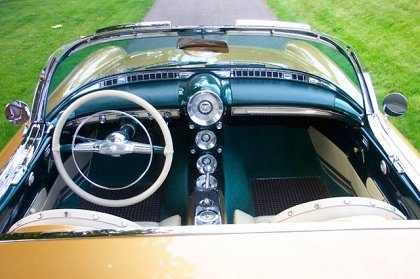
The 1956 Oldsmobile Golden Rocket Concept, a gold
colored 2 passenger car, which was styled to resemble a rocket, made its
debut at the 1956 General Motors Motorama and was used at many other
auto shows.
The Rocket had a fiberglass body with nerf-like built
in bumpers that give an overall rocket effect. It was powered with a
234 CID, 275 horsepower Rocket V8 engine and weighs 2,500 pounds.
The
upholstery was done in blue and gold leather. The speedometer was
mounted in the center of the two-spoked steering wheel along with
buttons to tilt the wheel, making it one of the first vehicles with a
tilt steering wheel.
As either door was opened, the roof panel
automatically raised and the seat came up 3 inches and swiveled outward
for easy entry or exit.
The Golden Rocket was revised several times and stayed on the show circuit for several years.
The
1956 Oldsmobile Golden Rocket featured a seating system in which a roof
panel was raised and the seat was elevated and rotated toward the
entering occupant when the door was opened. Buttons on the steering
wheel allowed the column to tilt downward, providing the driver with
easier access.
A
wild-looking bronze-metallic two-seat coupe was the most
projectile-like Olds show car, and one of the quickest: Its 234 V-8 was
tuned to produce 275 hp, which must have been impressive considering its
curb weight of about 2,500 pounds. Like most of its predecessors, the
Rocket had a fiberglass body. Roof panels rose, resembling Mercedes’
gullwing-style, and the seats lifted and swiveled out to welcome the
posterior when the doors were opened. Conventional bumpers were replaced
by nerf-like built-in bumpers, and one of the first-known tilt steering
wheels was in the cockpit.
Source: Internet
 Bright red with a brushed aluminum retractable hardtop, this low, sleek
two-seater was Earl’s design swan song. Its 102 inch wheelbase carried a
combination fiberglass and steel body, and it stood only forty-six
inches high. Inside were bucket seats and aircraft-type instruments
featuring rotating disc-type tachometer and speedometer, color-coded
according to range. To obtain a very low hood, there was a special
carburetor arrangement and an altered-from-stock crossflow aluminum
radiator. The muffler / exhaust system was mounted ahead of the engine,
exiting forward of the front wheels; an experimental Hydra-matic was
mounted in the rear to improve weight distribution. Harley Earl drove
the Mark III for a while during his retirement.
Bright red with a brushed aluminum retractable hardtop, this low, sleek
two-seater was Earl’s design swan song. Its 102 inch wheelbase carried a
combination fiberglass and steel body, and it stood only forty-six
inches high. Inside were bucket seats and aircraft-type instruments
featuring rotating disc-type tachometer and speedometer, color-coded
according to range. To obtain a very low hood, there was a special
carburetor arrangement and an altered-from-stock crossflow aluminum
radiator. The muffler / exhaust system was mounted ahead of the engine,
exiting forward of the front wheels; an experimental Hydra-matic was
mounted in the rear to improve weight distribution. Harley Earl drove
the Mark III for a while during his retirement.