Thursday, February 28, 2013

1955 Packard Request

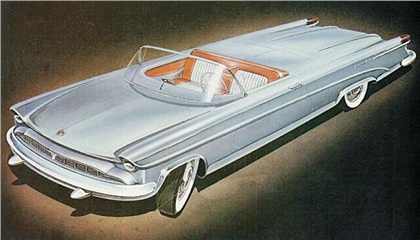
Due to a steady flow of requests to bring out a modern interpretation of its classic pre-war grille, Packard developed the "Request" prototype and debuted it at the 1955 Chicago Auto Show. Based on the 1955 Packard 400 two-door hardtop, the front design on the Request dream car did characterize the traditional grille, and the car also wore custom-built split bumpers and modified front sheet metal. Creative Industries constructed the one-of-a-kind Request for Packard, and the handsome 2-tone exterior was painted in pearlescent white, with copper-colored top and side accent strips

A third Creative-Packard project was the 1955 Packard Request show car which debuted at the 1955 Chicago Auto Show. Packard had received a number of requests to bring out an up-to-date version of their pre-1951 classic-era radiator and decided to placate the critics with their "Request", hence the 1955 Request show car.
Designed by Dick Teague, the Request was built using a modified Patrician with a new front end treatment utilizing a classic-era Packard-style grill separated by two massive front bumpers. The vehicle’s hood and fenders were molded using reinforced Plaskon polyester resin, a product of the Barrett Division of Allied Chemical. In a 1978 interview with Leon Dixon, Creative’s Gary Hutchings recalled: "We had a heck of a time finding a place with tanks big enough to plate those huge front bumpers. We finally got ’em done over in Hamtramck (a Detroit suburb)."
Source: Internet

1954 Packard Panther Daytona

1954 Packard Grey Wolf II / Panther / Panther Daytona

The 1954 Packard Panther Convertible was produced as a concept car with muscle. Packard also designed the Panther with then-revolutionary materials in mind.

Chevrolet wasn’t the only major automaker tinkering with the use of glass-reinforced plastic (GRP) in auto bodies in the 1950s. Packard — which had considered using this then-revolutionary material as early as 1941, primarily as a means of continuing auto production in the face of wartime steel shortages — was dabbling in the field, too.

In 1953, the company again considered using the material and decided to build a two-seat convertible sports car with a GRP body.

Packard’s chief stylist, Richard A. Teague, was given the task of hastily styling the car. No time was allowed for him to construct a full-size mock-up, so management approved his design directly from a small one-sided model.

A running version was completed in 1954, using the 127-inch wheelbase Cavalier chassis and the metal floorpan common to all Packards of that year.

It was originally to be called "Grey Wolf II," after Packard’s famed 1903 race car. But upper management didn’t like the name’s connotation, so "Panther" was chosen instead.

To lend its massive "sports car" some performance credentials, Packard gave the Panther a 359-cubic inch straight eight, the biggest engine available. The first two cars got McCulloch centrifugal superchargers, boosting the engine’s output to 275 horsepower.

Despite the car’s rather generous dimensions, it actually performed well, at least in a straight line. With no major modifications other than a small racing windshield, Panther Number 2 went 131.1 mph at Daytona Beach, Florida, an unofficial class record.
But ultimately, the Panther was overshadowed by Packard’s many other woes, relegating the car to a sidebar in the last chapter of the venerable company’s history.

Only four Panthers were made, all of them essentially hand-built prototypes. Packard never seriously considered putting the car into production, despite heavy lobbying by one of its distributors.

Today people’s opinions of the Panther seem to be mixed. Packard enthusiasts will generally admit that the front end is not particularly elegant but consider the rest of the car sleek and interesting.

Designer Richard Teague wasn’t so kind. In 1986, he said of the Panther, "I can’t stand it. But then, I didn’t like anything I did."

All four Panthers are believed to still exist. The silver example shown here is the first one. It is owned by the Mitchell Corporation of Owosso, which finished the bodies and interiors for the Panthers. The car, bearing added Mitchell nameplates, is currently housed in the company’s private museum in Owosso, Michigan.
Source: Internet

1953 Packard Balboa-X

Designed by Richard Teague

The 1953 Packard Balboa-X, as it was officially called, was a hardtop based on the Packard Caribbean convertible. The main point of interest on the car was the canopy-style C-pillar. Caribbeans never recieved a hardtop like the Balboa's, but they got a conventional one (covered with Hypalon) in 1956.

Drivetrain of the Balboa-X was stock Caribbean with a 327 c.i. Straight Eight that was distinguished from lesser Clippers Deluxe's engine by hydraulic valve train adjustment, and from the more expensive Patrician 327 by 5 instead of 9 main bearings.
Source: Internet

1952 Packard Special Speedster


Source: Internet

1952 Packard Pan-American

The Packard Pan-American is a concept car produced for the Packard Motor Car Company of Detroit, Michigan in 1952.

Conceived as a moderate-performance two-seater by Hugh Ferry, president of Packard, it was built by Henney, which was responsible for fitting custom hearse and ambulance bodies on Packard chassis. A status symbol for a carmaker at the time, this sort of car was a very unlikely project for Packard.

With styling by Henney, it was based on the 1951 Series 250 convertible, and ready in time for the 1952 New York International Motor Sports Show. Sectioned and channelled, in a fashion reminiscent of the 1953 Skylark, and wearing the trademark Packard grille, it "was elegantly trimmed throughout".

Packard spent US$10,000 building the Pan-American, and management tried in vain to imagine, let alone develop, a market for a roadster projected to cost at least US$18,000, at a time when the top-line Lincoln Capri six-passenger convertible went for US$3,665, the premier eight-place Cadillac Series 75 Fleetwood US$5643, and even Packard's Patrician 400, their most expensive production model, was only US$3,767, and a six-seater.

As many as six examples were built. The Pan-American did inspire a successful six-place model, the Cavalier, which debuted in 1953.
Source: Internet

1948 Hudson Commodore

1948-1949

The major innovation of the Hudson line was the "step-down" design. Unlike traditional body-on-frame construction which forced passengers to climb up to enter their vehicles, Hudson designers placed the passenger compartment down inside the chassis. A sturdy perimeter frame encircled the passenger compartment. As a result, Hudson passengers stepped down into the car. The result was a low center of gravity and enhanced road holding.
Source: Internet

1954 Hudson Italia (Touring)

Hudson Italia (1954-'55): Hudson's swan song, sung in Italian

The Hudson Motor Car Company was founded in 1909 and quickly found favor for its cars' solid engineering and well-rounded performance, traits that they brought to their stylish and successful post-war Step-Down cars. With the automaker financially struggling but looking towards the future in the early 1950s, their compact Jet sedan would form the foundation for a bewitching, handcrafted sports coupe with one of the most distinctive faces of the immediate post-war era.

What is this unusual Hudson, with its sporty egg-crate grille, distinctive triangle-peaked front bumper and wild fender-top air intakes? It's an Italia! There is a very good reason why the stylish grille of the 1954-1955 Italia very much resembles that of a Pinin Farina-styled Ferrari of the period. This car was penned by Hudson's director of styling, Frank Spring, a cosmopolitan American, educated in Europe, who kept abreast of international styling trends of the day. Adding input to the car's design was Carlo Felice Bianchi Anderloni, chief designer of Carrozzeria Touring of Milan, whose firm was celebrated for their beautiful designs and lightweight "Superleggera" construction methods. Carrozzeria Touring would use this method to build the aptly named car.

The egg-crate grille used on all 25 production Italias differs from the one on the prototype that was presented to Hudson executives for approval; while the pre-production coupe featured a shallow grille whose central cross-hatch element was cast as a single unit, similar in style to the texture seen on 1956-1957 Hudsons, the Italias that followed that pre-production model all used a complex unit made from individual elements. The metal in production grilles was chrome-plated brass, chosen for its easy workability and inexpensive cost.
Source: Internet