One
day in June two years ago, David Nittler was driving through the small
town of Dilley, Texas, population about 3,600, when he spotted a blue
1950 Ford four-door sedan parked on a trailer by the road. The car had a
“for sale” sign in one of the windows.
One
day in June two years ago, David Nittler was driving through the small
town of Dilley, Texas, population about 3,600, when he spotted a blue
1950 Ford four-door sedan parked on a trailer by the road. The car had a
“for sale” sign in one of the windows.Nittler continued on home to nearby Cotulla, Texas, to share this information news with his family. His initial thought was to fix up the old car and then sell it for a profit.
The next day Nittler returned to inspect the Ford with his advisor and consultant, his 9-year-old granddaughter, Jessica. She determined that the antique Ford would be a worthwhile purchase, and with that executive decision made the deal was done.
Nittler had not even had a chance to open the engine hood to see the engine — or to even see if there was an engine. The car was purchased on Father’s Day 2009. Since the Ford sedan was already displayed on a trailer the seller agreed to trailer the car to the buyer’s home.
Paperwork that came with the car indicates that when new it was sold by a Ford dealer in Flatonia, Texas, to a customer in San Antonio. Decades later the car was sold to the man in Dilley from whom it was purchased by Nittler, who is now the third owner of the 61-year-old car.
In 1950 Ford offered a Deluxe line of cars as well as an upscale Custom line with more chrome trim and gadgets. The four-door Ford that Nittler purchased was one of the economy models. That meant there were no armrests on the doors and no horn ring to accent the horn button at the hub of the steering wheel. When new the Ford had a base price of $1,472.
Bright trim surrounding the two-piece windshield and rear window was eliminated. Additionally, the rear vent windows are fixed. Only the vent windows in the front doors are operational.
Beneath the hood is a 226-cubic-inch, six-cylinder engine that develops 95 horsepower. The original owner evidently shunned the 239.4-cubic-inch flathead V-8 engine that produced 100 horsepower.
Below the combination chrome and Plexiglas ornament on the leading edge of the engine hood is the Ford crest, which replaced the chrome letters from the 1949 model that spelled out F O R D.

The bigger engine and additional trim might have been inducements for customers to go upscale but 77,888 bargain hunters in 1950 bought Fords like the one Nittler now has.
His 3,064-pound Ford rides on 6.70×14-inch tires supported by a 114-inch wheelbase. The trunk is deep enough to permit the spare tire to be mounted vertically on the right side of the trunk.
“It’s a pretty basic car,” Nittler says.
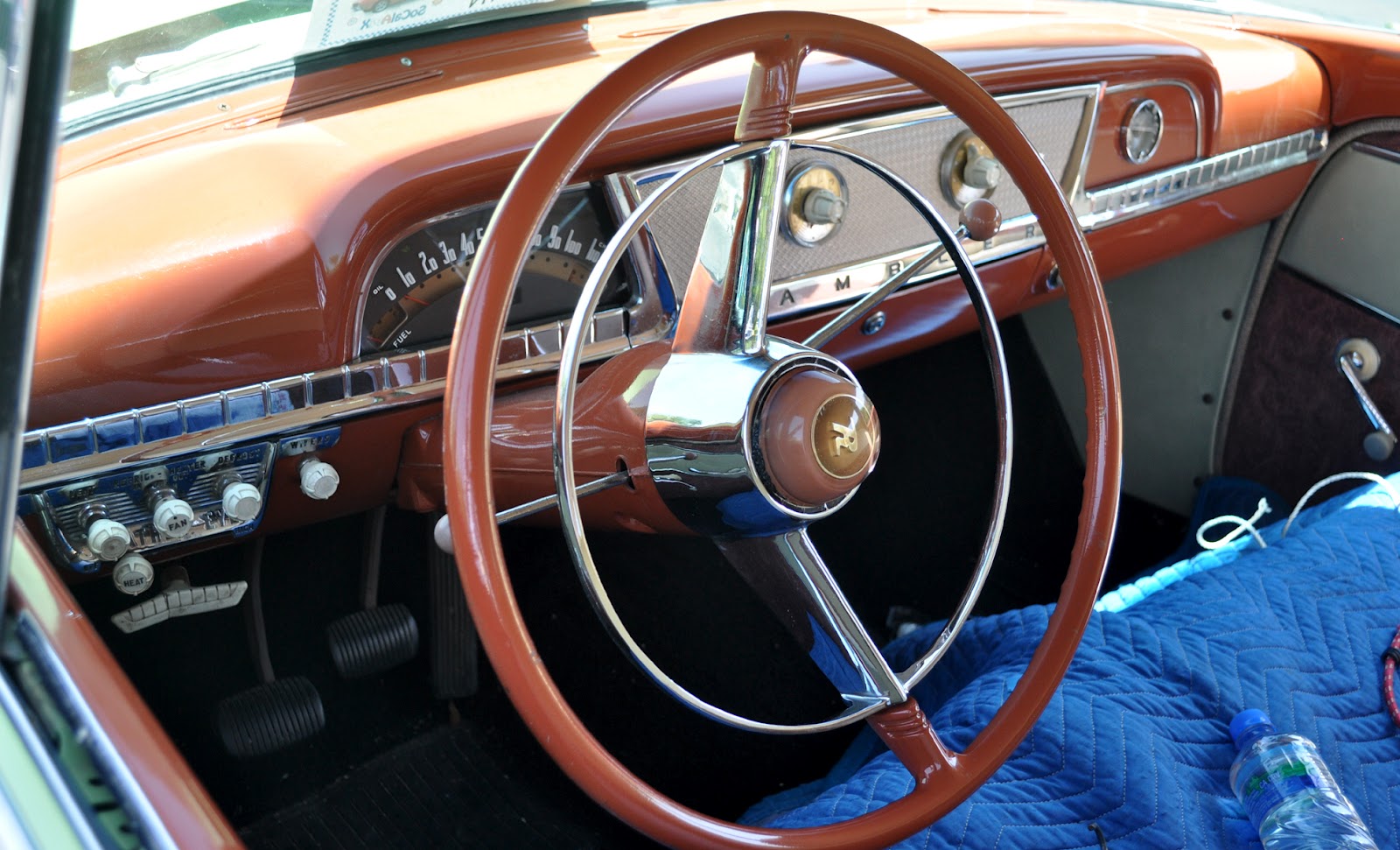
In the center of the dashboard is a metal “delete” plate for where the radio would be and one for where the clock would be, too. Under the dashboard is the singular Magic Aire accessory, a heater.
Even the heater is questionable, Nittler says. The heater controls are from a 1949 Ford, which leads him to believe that his car is an early 1950 model and that Ford was simply using up some leftover parts from the 1949 models.
Nittler has now realized that he can never sell the Ford, despite his initial intention to do so. His wife, Aida, has named the Ford “The Tank.” Nittler says, “Once a car has acquired a name it can’t be sold.” — Vern Parker, Motor Matters
Source: askautoexperts.com






 The Station
Wagon is an American classic. Station Wagons look better, handle
better, and are more practical than any mini van or "SUV" could ever
hope to be. They make great project cars, hot rods, and even race cars.
It goes without saying that station wagons are the ultimate family car.
Their unique combination of styling, utility , and drivability is
unmatched by any other car. If you've experienced a Station Wagon, you
already know how awesome they are for road trips, vacations, family
life, etc. If you don't know, keep reading to find out why these cars
just flat rock...
The Station
Wagon is an American classic. Station Wagons look better, handle
better, and are more practical than any mini van or "SUV" could ever
hope to be. They make great project cars, hot rods, and even race cars.
It goes without saying that station wagons are the ultimate family car.
Their unique combination of styling, utility , and drivability is
unmatched by any other car. If you've experienced a Station Wagon, you
already know how awesome they are for road trips, vacations, family
life, etc. If you don't know, keep reading to find out why these cars
just flat rock... The
very first Station Wagons were called "depot hacks." Depot hacks
weren't production vehicles; they were based on a commercial chassis
(usually Ford) with a custom body built by independent companies for
extra passenger and cargo space. These hacks (taxis) were used to haul people and their luggage to and from the train depot, hence the term depot hack. Over time, the term station replaced depot, wagon replaced hack, and these specialty vehicles became known as Station Wagons. The first commercially produced wagon, the Star, was introduced in 1923.
The
very first Station Wagons were called "depot hacks." Depot hacks
weren't production vehicles; they were based on a commercial chassis
(usually Ford) with a custom body built by independent companies for
extra passenger and cargo space. These hacks (taxis) were used to haul people and their luggage to and from the train depot, hence the term depot hack. Over time, the term station replaced depot, wagon replaced hack, and these specialty vehicles became known as Station Wagons. The first commercially produced wagon, the Star, was introduced in 1923.
 (Photo:

 In 1973, my parents purchased a brand new Dodge Coronet Crestwood station wagon with a
 For
a True Believer, any station wagon is better than a non-wagon, but
among wagons some are better than others. Station Wagon styles are at
least as varied as other types of cars and no matter what your
preferences are there is probably a Station Wagon suited for you. If you
like "sporty," one of the compact wagons (Chevy Nova, Dodge Dart, Ford
Falcon, or Plymouth Valiant) would probably be most to your liking. If
you have a big family or lots of stuff to haul around you may prefer one
of the full size wagons. If you want excellent handling and good road
manners a mid-80's GM wagon (Olds Cutlass Cruiser, etc) might be your
best choice. Here is a list of some of my favorite wagons and why
they're my favorites...
For
a True Believer, any station wagon is better than a non-wagon, but
among wagons some are better than others. Station Wagon styles are at
least as varied as other types of cars and no matter what your
preferences are there is probably a Station Wagon suited for you. If you
like "sporty," one of the compact wagons (Chevy Nova, Dodge Dart, Ford
Falcon, or Plymouth Valiant) would probably be most to your liking. If
you have a big family or lots of stuff to haul around you may prefer one
of the full size wagons. If you want excellent handling and good road
manners a mid-80's GM wagon (Olds Cutlass Cruiser, etc) might be your
best choice. Here is a list of some of my favorite wagons and why
they're my favorites... The 62 Plymouth Valiant
had front end styling that was, uhmmm, different and not exactly in a
good way. I guess you could say they had a face that only Ma Mopar could
love. Other than the front treatment, though, it's actually a pretty
good looking car.The thing that makes the '62 Valiant wagon my favorite
station wagon, though, is that one of the engine options was a high
compression, 4-bbl 383 big block. The engine compartment is a little
crowded for headers, but the F.A.S.T. guys are running in the 11's
through stock exhaust manifolds so that isn't really a problem. This car
could be both a grocery getter and a street terror at the same time. A
stroked and mildly built Mopar 400 would make this wagon haul a lot more
than just groceries while still having good street manners.
The 62 Plymouth Valiant
had front end styling that was, uhmmm, different and not exactly in a
good way. I guess you could say they had a face that only Ma Mopar could
love. Other than the front treatment, though, it's actually a pretty
good looking car.The thing that makes the '62 Valiant wagon my favorite
station wagon, though, is that one of the engine options was a high
compression, 4-bbl 383 big block. The engine compartment is a little
crowded for headers, but the F.A.S.T. guys are running in the 11's
through stock exhaust manifolds so that isn't really a problem. This car
could be both a grocery getter and a street terror at the same time. A
stroked and mildly built Mopar 400 would make this wagon haul a lot more
than just groceries while still having good street manners. I found my 62 Buick Special
on eBay. It's in very nice Number 3 condition and I bought it for
slightly less than Number 3 price so I'm pretty happy. This little car
has a wheel base of 112", so it's about half way in size between the
compact wagons (Mopar Valiant or Dart, Ford Falcon) and the full size
station wagons. In spite of being smaller than it full size wagon, it
handles like a land yacht but it's still fun to drive. The Buick Special
Series 4000 came with Buick's odd-fire V6 (not exactly the smoothest
running engine ever produced) but the Special DeLuxe Series 4100 came
with Buick's excellent little all aluminum V8. If you can find one of
these in good condition it would make a really nice station wagon to
collect or drive on special occasions. Keep in mind that it's not the
most popular wagon ever produced, so parts might be hard to find. This
is especially important if you find a basket case you want to restore -
at least if you hope to restore it to stock appearance.
I found my 62 Buick Special
on eBay. It's in very nice Number 3 condition and I bought it for
slightly less than Number 3 price so I'm pretty happy. This little car
has a wheel base of 112", so it's about half way in size between the
compact wagons (Mopar Valiant or Dart, Ford Falcon) and the full size
station wagons. In spite of being smaller than it full size wagon, it
handles like a land yacht but it's still fun to drive. The Buick Special
Series 4000 came with Buick's odd-fire V6 (not exactly the smoothest
running engine ever produced) but the Special DeLuxe Series 4100 came
with Buick's excellent little all aluminum V8. If you can find one of
these in good condition it would make a really nice station wagon to
collect or drive on special occasions. Keep in mind that it's not the
most popular wagon ever produced, so parts might be hard to find. This
is especially important if you find a basket case you want to restore -
at least if you hope to restore it to stock appearance. My 62 Buick Special is just a little bigger than my 64 Valiant, so I
guess that makes it a mid-size station wagon. The similarities are kind
of eerie... both have 13" wheels, both have similar displacement (215
cu. in. for the Buick and 225 for the Mopar), and they both use engines
that were newly designed at the time the cars were built.
My 62 Buick Special is just a little bigger than my 64 Valiant, so I
guess that makes it a mid-size station wagon. The similarities are kind
of eerie... both have 13" wheels, both have similar displacement (215
cu. in. for the Buick and 225 for the Mopar), and they both use engines
that were newly designed at the time the cars were built.
 The 1963 Ford Falcon
was the last year of the rounded body style. The Falcon station wagon
was a compact wagon about the same size as the Plymouth Valiant and the
Chevy Nova. Like those other 2 wagons, the Falcon is light enough to
perform well with an inline six cylinder engine. If I ever get my hands
on 1 of these wagons, that's what I'll use. The 200 is the largest of
Ford's Falcon series inline sixes (not sure about the 250) so that's
what I'd build. The intake is kind of funky being cast as part of the
head, but Offenhauser makes an adapter that (with a little machine work)
lets you mount 3 stock 1-bbl carburetors with progressive linkage.
Clifford Performance sells headers and cams, put together right this
would be a neat little car.
The 1963 Ford Falcon
was the last year of the rounded body style. The Falcon station wagon
was a compact wagon about the same size as the Plymouth Valiant and the
Chevy Nova. Like those other 2 wagons, the Falcon is light enough to
perform well with an inline six cylinder engine. If I ever get my hands
on 1 of these wagons, that's what I'll use. The 200 is the largest of
Ford's Falcon series inline sixes (not sure about the 250) so that's
what I'd build. The intake is kind of funky being cast as part of the
head, but Offenhauser makes an adapter that (with a little machine work)
lets you mount 3 stock 1-bbl carburetors with progressive linkage.
Clifford Performance sells headers and cams, put together right this
would be a neat little car.
 The 1962 - 65 Chevy Nova station wagon
has an unfair advantage over other early compact wagons like the
Plymouth Valiant or Ford Falcon - it readily accepts the small block
Chevy. In my opinion though, this little station wagon is a much better
fit for Chevy's inline 6. The Nova station wagon was produced in much
larger quantities than the Dart, Valiant, and Falcon station wagons, so
it's a lot easier to find one in good condition. Of all the station
wagons on my list, the early Nova wagons are the easiest to find.
They're also more popular than the other wagons, so prices can tend to
be high in spite of the better availability. Even so, nice examples of
the Nova wagon can be found for around $5-15,000 or less if you're
patient. Basket cases can be found for as low $500. Unlike some of the
other station wagons on my list, parts for the Nova are easy to find
(it's a Chevy after all) so you don't need to shy away from the basket
cases for fear of not being able to find parts. This may just be the best entry level station wagon you can get into.
The 1962 - 65 Chevy Nova station wagon
has an unfair advantage over other early compact wagons like the
Plymouth Valiant or Ford Falcon - it readily accepts the small block
Chevy. In my opinion though, this little station wagon is a much better
fit for Chevy's inline 6. The Nova station wagon was produced in much
larger quantities than the Dart, Valiant, and Falcon station wagons, so
it's a lot easier to find one in good condition. Of all the station
wagons on my list, the early Nova wagons are the easiest to find.
They're also more popular than the other wagons, so prices can tend to
be high in spite of the better availability. Even so, nice examples of
the Nova wagon can be found for around $5-15,000 or less if you're
patient. Basket cases can be found for as low $500. Unlike some of the
other station wagons on my list, parts for the Nova are easy to find
(it's a Chevy after all) so you don't need to shy away from the basket
cases for fear of not being able to find parts. This may just be the best entry level station wagon you can get into. The Olds Vista Cruiser
was introduced in 1964. A really unique feature was a split glass
skylight over the 2nd seat and small glass panels over the rear cargo
area windows. In 1967, the Vista Cruiser was restyled, resulting in one
of the best looking station wagons to ever be produced (IMHO). The
standard engine was an Olds Rocket 350, with the Olds 400 from the 4-4-2
becoming available in 1968. In 1970, the Olds 455 became an option.
Transmission options were a 2 or 3 speed automatic or a 3 or 4 speed
manual. The 69 Vista Cruiser is my favorite because it had the styling
of the early 2nd generation Cruisers (in 1970 Olds changed the styling)
and a "Dual Action" tailgate. The standard engine and transmission
offerings are adequate, but if I ever get my own Vista Cruiser I'm going
to run a Cadillac 500 V8 backed by a 4 speed automatic overdrive
transmission. The 69 Vista Cruiser is a really good looking car and it's
probably my favorite station wagon, even though it's not a Mopar.
The Olds Vista Cruiser
was introduced in 1964. A really unique feature was a split glass
skylight over the 2nd seat and small glass panels over the rear cargo
area windows. In 1967, the Vista Cruiser was restyled, resulting in one
of the best looking station wagons to ever be produced (IMHO). The
standard engine was an Olds Rocket 350, with the Olds 400 from the 4-4-2
becoming available in 1968. In 1970, the Olds 455 became an option.
Transmission options were a 2 or 3 speed automatic or a 3 or 4 speed
manual. The 69 Vista Cruiser is my favorite because it had the styling
of the early 2nd generation Cruisers (in 1970 Olds changed the styling)
and a "Dual Action" tailgate. The standard engine and transmission
offerings are adequate, but if I ever get my own Vista Cruiser I'm going
to run a Cadillac 500 V8 backed by a 4 speed automatic overdrive
transmission. The 69 Vista Cruiser is a really good looking car and it's
probably my favorite station wagon, even though it's not a Mopar.
 The ChryslerTown and Country
is one of my favorite full size station wagons. It was available in
both 6 passenger and 9 passenger models; the 9 passenger Town and
Country had a folding 3rd seat that faced to the rear of the car. This
wagon was huge and is one of the largest station wagons ever produced.
Lots of room to haul a large family, camping gear, all your worldly
possessions, etc. To get all that mass moving, the best engine is
Chrysler's excellent 440 (the Town and Country was offered with several
lesser engines as well). If you can find one of these, it would make an
excellent family car (don't expect great gas mileage though), tow car,
or a great
The ChryslerTown and Country
is one of my favorite full size station wagons. It was available in
both 6 passenger and 9 passenger models; the 9 passenger Town and
Country had a folding 3rd seat that faced to the rear of the car. This
wagon was huge and is one of the largest station wagons ever produced.
Lots of room to haul a large family, camping gear, all your worldly
possessions, etc. To get all that mass moving, the best engine is
Chrysler's excellent 440 (the Town and Country was offered with several
lesser engines as well). If you can find one of these, it would make an
excellent family car (don't expect great gas mileage though), tow car,
or a great  The Datsun 510
series was a neat little car produced from 1968 - 1974. The coupes were
popular in certain sports car racing classes and are considered
collectible today, but I like the station wagon version of the 510. It
is very small by American station wagon standards, but it has all the
requisites - 4 doors, fold-down rear seat, "wagon" roof line, and rear
hatch. The 510 wagon is also rear wheel drive which is always a plus but
rare for Japanese cars. The engine is pre-smog, reliable, easy to work
on, and easy to modify. For a reliable daily driver you can just leave
the engine stock, but a few hop-ups coupled with a beefed up chassis and
some suspension mods would make the 510 wagon perfect for Pro Rally or
blasting down the fire roads through your local forest. As a street
machine, the 510 would make an outstanding sleeper if you put in a later
model Nissan engine with a turbo running lots of boost. I want one...
The Datsun 510
series was a neat little car produced from 1968 - 1974. The coupes were
popular in certain sports car racing classes and are considered
collectible today, but I like the station wagon version of the 510. It
is very small by American station wagon standards, but it has all the
requisites - 4 doors, fold-down rear seat, "wagon" roof line, and rear
hatch. The 510 wagon is also rear wheel drive which is always a plus but
rare for Japanese cars. The engine is pre-smog, reliable, easy to work
on, and easy to modify. For a reliable daily driver you can just leave
the engine stock, but a few hop-ups coupled with a beefed up chassis and
some suspension mods would make the 510 wagon perfect for Pro Rally or
blasting down the fire roads through your local forest. As a street
machine, the 510 would make an outstanding sleeper if you put in a later
model Nissan engine with a turbo running lots of boost. I want one...
 Because of the memories I have of family vacations in one of these, the 1974 Dodge Crestwood
is my absolute favorite car. My parents' 74 Crestwood wagon took us
safely on many family vacations, taught me how to drive, got me back and
forth to my first job, and gave me my first taste of independence.
Unfortunately I was stupid at the time and didn't appreciate the finer
points of owning and driving a Station Wagon. One of my last acts before
joining the Air Force was stripping this beautiful, mint condition car
of the engine and transmission and towing the body to the county dump -
an act I'm now ashamed of of and hope God will forgive me for. I still
have the engine in my garage. The Coronet wagon's base engine was
Chrysler's 318, but a car this large really needs at least a 360. 383's
and 440's were also available as options. When I find my 74 Coronet it's
going to run a Mopar 360 stroked to 400 cubic inches.
Because of the memories I have of family vacations in one of these, the 1974 Dodge Crestwood
is my absolute favorite car. My parents' 74 Crestwood wagon took us
safely on many family vacations, taught me how to drive, got me back and
forth to my first job, and gave me my first taste of independence.
Unfortunately I was stupid at the time and didn't appreciate the finer
points of owning and driving a Station Wagon. One of my last acts before
joining the Air Force was stripping this beautiful, mint condition car
of the engine and transmission and towing the body to the county dump -
an act I'm now ashamed of of and hope God will forgive me for. I still
have the engine in my garage. The Coronet wagon's base engine was
Chrysler's 318, but a car this large really needs at least a 360. 383's
and 440's were also available as options. When I find my 74 Coronet it's
going to run a Mopar 360 stroked to 400 cubic inches. This Coronet station wagon recently sold in Reno - the asking price was less than $5000!!!.
I checked it out but didn't buy it 'cause my wife said if I got it I'd
have to sell my Buick Special and that "ain't happening." It was a very
nice car though - great paint, zero rust (very rare for a Mopar), decent
interior, and a 400 big block. I can just imagine this with a stroked
engine - around 472 inches - and a Six Pack intake. Oh well, some day...
This Coronet station wagon recently sold in Reno - the asking price was less than $5000!!!.
I checked it out but didn't buy it 'cause my wife said if I got it I'd
have to sell my Buick Special and that "ain't happening." It was a very
nice car though - great paint, zero rust (very rare for a Mopar), decent
interior, and a 400 big block. I can just imagine this with a stroked
engine - around 472 inches - and a Six Pack intake. Oh well, some day... My parents bought a brand new Dodge Coronet Crestwood wagon when I was 8
or 9 years old and it was the family car for about 10 years. I have
many memories tied to that car - trips to Sacramento to visit my
grandparents, learning how to drive, my first date, cruising with my
friends, crawling under the dashboard to disconnect the odometer so my
dad wouldn't know how many miles I'd put on it when I was out with my
friends... Some day I'm going to have one of my own.
My parents bought a brand new Dodge Coronet Crestwood wagon when I was 8
or 9 years old and it was the family car for about 10 years. I have
many memories tied to that car - trips to Sacramento to visit my
grandparents, learning how to drive, my first date, cruising with my
friends, crawling under the dashboard to disconnect the odometer so my
dad wouldn't know how many miles I'd put on it when I was out with my
friends... Some day I'm going to have one of my own.